Technical Information
Model Railway Scales
Model railways come in numerous scales, i.e., reduction ratios compared to the real-world prototype. Our club's primary N scale offers a unique balance between realism and efficient use of space. The N-scale ratio is 1:160, which means that 1 mm in the model corresponds to 160 mm in the real world. The compact size of N scale allows for larger layouts, longer trains, and more detailed scenery in the same space compared to, for example, the popular H0 scale (1:87). This makes N scale ideal for modular exhibition layouts, home layouts, dioramas, and other creative projects where space is limited.
Z scale (1:220) allows for extremely compact layouts in small spaces. In such a small-scale hobby, the extremely small size of the models introduces additional challenges, making Z scale less suitable for beginners.
Both N and Z scales are based on standard gauge track, scaled down accordingly. Narrow gauge tracks also exist, and there is a narrow gauge version of N scale, Nm, with the same 1:160 ratio as standard N scale, but with a narrower track gauge of 6.5mm compared to the 9mm of standard N rolling stock.
Standards and Compatibility
Shared standards and best practices ensure that modules, rolling stock, and electrical systems work seamlessly across clubs and countries. NEM and NMRA guidelines define track geometry, couplers, wheel profiles, and wiring practices, enabling reliable operation at events and on modular layouts.
Digital Control
Digital control systems like Digital Command Control (DCC)↗️ or Selectrix↗️ bring flexibility and realism to N‑scale operations. With digital control, multiple locomotives can run independently on the same track, and features like lighting, sound, and speed curves can be fine‑tuned for each model. Proper wiring and decoder installation ensure smooth performance.
Layout Construction
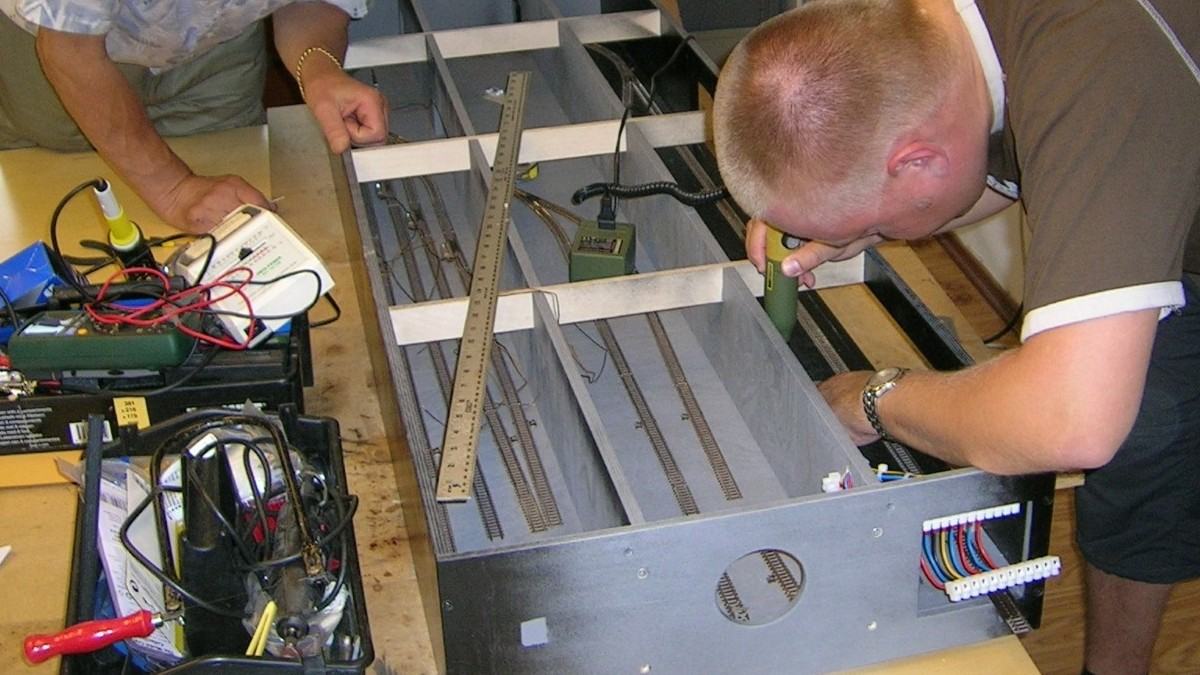
Building an N‑scale layout involves careful planning of track - often using a CAD-system, optimising electrical wiring, and scenery. Power sections, turnout control, and reliable feeders are essential for consistent running. Lightweight baseboards and modular construction make transport and exhibition setups easier.
3D-Printing and Etching
Modern modelling techniques allow highly detailed custom parts. 3D‑printing enables rapid prototyping of buildings, details, and rolling stock components, while photo‑etching provides fine metal parts such as handrails and ladders. These methods expand what can be built beyond commercial offerings.